
97K Enhanced YBCO Created

Higher Tc and higher Jc !


18 November 2006
Updated 17 January, 2007
SEE NOTE 2 AT BOTTOM OF PAGE

Superconductors.ORG

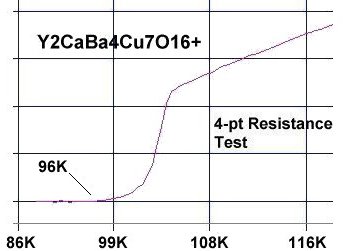
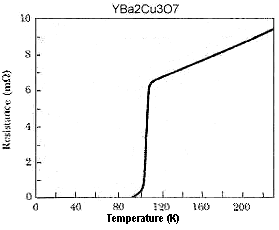
       Superconductors.ORG reports the discovery of a new YBCO variant with Tc of 97K and higher current-carrying capability than standard (92K) YBCO. A plot of the material's resistance-vs-temperature (R-T) is shown above alongside a standard YBCO plot. The chemical formula of this compound is Y2CaBa4Cu7O16+


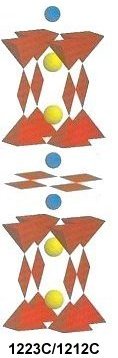
       Though prior research has found that calcium doping depresses the Tc of YBCO, in this new formulation Tc is increased. This is due to an additional layer being added to the unit cell. Like the previous "Super YBCO" discoveries, planar weight disparity is the driving mechanism behind the enhanced Tc. However, unlike Super YBCO, heavy rare earths are not required. Instead, two yttrium atoms are positioned to alternate with a single calcium atom in the CuO2 planes (shown at left1,2). Thus, the new formulation is neither 123, 124 nor 247; but rather, an intergrowth of 1212C and 1223C structures.

      The claim of a higher current-carrying capability in this material arises from a May 2005 report by BNL researchers who found that doping YBCO with calcium increases the amount of current the material can carry. Brookhaven National Laboratory scientists found that calcium substitution changes the atomic structure at the grain boundaries, providing additional “pathways” for electric charge carriers to pass. It was determined that calcium doping can increase the current across the grain boundary by as much as 35 percent.

      According to Brookhaven physicist Robert Klie, “Where the atoms are tightly packed, a calcium atom replaces a larger barium atom, relieving the strain. Oppositely, in loosely packed areas, the calcium replaces a smaller copper atom, which relaxes strained areas that are nearby.”

       While this new formulation contains calcium uniformly throughout, rather than in just the grain boundaries, a Jc increase in the bulk seems likely. A multi-phasic superconductor can be represented as being a number of superconducting resistors in series (with zero ohms each). The net resistance at a given temperature can be no lower than the highest resistance in the series. Once a single resistor has reached Tc, Jc, or Hc, the bulk will no longer show zero ohms. A bulk of YBCO with calcium only at the grain boundaries can be represented by two superconducting resistors. One is "perfect" YBCO without any grain boundaries at all. And the other as Ca-doped-YBCO. When one of these two resistors reaches Jc, a non-zero net resistance will appear. Ergo, YBCO with calcium must have a Jc at least as great as perfect YBCO. Or, in this case, as great as YBCO with calcium doping at its boundaries.

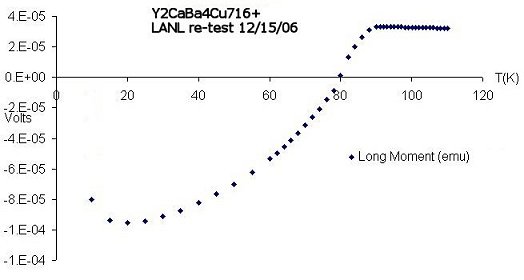
       Like most "novel" materials, this compound displays unusual magnetic properties. Using twin Hall effect sensors (very low imposed magnetic field) a diamagnetic transition appears at around 100K. (see above plot). However, with an imposed field of 1.00 Oe, the Los Alamos Superconductivity Lab showed diamagnetism at lower temperatures (see below plot).

       Previously, the greatest Tc improvement that could be realized from standard YBCO was creation of the "247" structure which has a resistive Tc of 95K. The "247" is an intergrowth of 1212C and 2212C structures. Two of the "Super YBCO" formulations produced Tc's of 107K and 105K, but required more expensive lutetium and thulium to synthesize. Whereas, this material should be inexpensive to manufacture.

       Synthesis of the material was by the solid state reaction method. Stoichiometric amounts of the below precursors were mixed, pelletized and sintered for 11 hours at 890C. The pellet was then annealed for 10 hours at 500C in flowing O2.

Y2O3 99.99%   (Alfa Aesar)
BaCuOx 99.9%   (Alfa Aesar)
CaCO3 99.95%   (Alfa Aesar)
CuO 99.995%   (Alfa Aesar)


- E. Joe Eck
© 2006 Superconductors.ORG
Patent pending US60/859,616
All rights reserved.


Note 1. The structure graphic shows "typical" locations for yttrium and calcium in the layered copper-oxides. If the placement of these two elements were incorrect, planar weight disparity would not exist and the Tc increase would not have occured. Thus, the structure is believed to be empirically correct.

Note 2. Subsequent tests have shown that the bulk resistance of this material does not reach zero ohms. This appears to be a result of YCa-Y and CaY-Y structures intermixing with the desired YY-Ca. In order to be commercially viable, a way will need to be found to synthesize a homogenous YY-Ca bulk.


  BACK to "News" page at Superconductors.ORG