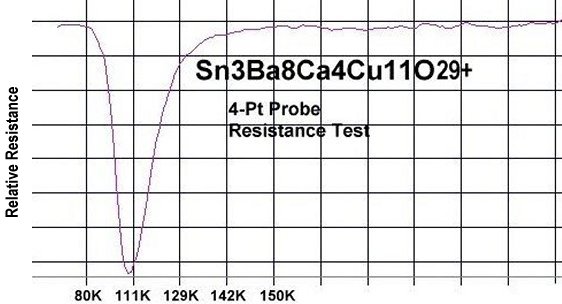
In 2006 a novel copper-oxide superconductor was discovered by Superconductors.ORG that had a critical transition temperature of 109 Kelvin - and ONLY 109 Kelvin (see graphic at page top). This material was not only unique among superconductors, but suggested that there is a more complicated mechanism at work in facilitating high-temperature superconductivity (HTSC). An explanation for that 2006 discovery has just been found.
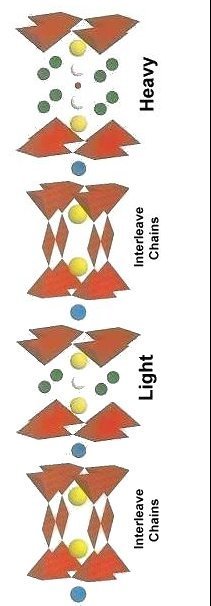 |
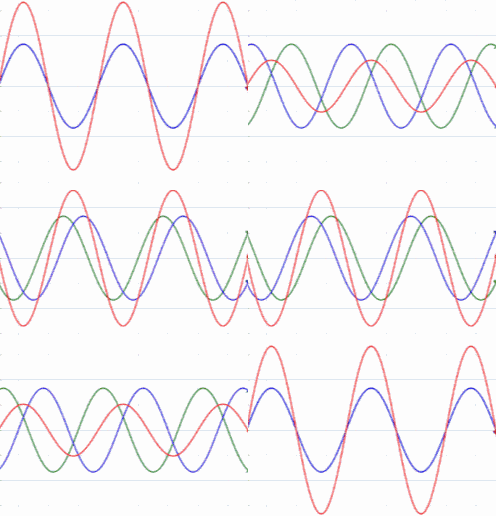
HTSC theory for the copper-oxides posit that the Cooper-pairing of electrons comes about through a wave function. Planar weight disparity on opposite sides of oxygen atoms promotes pulsing compression, and therefore the movement of electrons by increasing the overlap of electron wave functions. And, since copper atoms have a variable valency, they offer available "parking" for an electron to jump atomic sites. Copper-oxide is antiferromagnetic (AF). So when an electron is lost or an atom is compressed, AF gives way to ferrimagnetism. Alongside these CuO2 planes are doping (insulating) layers that hold an electrostatic charge. As such they have been dubbed "charge reservoirs" (AKA capacitors). When pulsing ferrimagnetism and capacitance are coupled together electronically, they become a tuned circuit and resonate at a fixed frequency. Thus, the random lattice vibrations caused by internal heat within a material can be tamed by resonance. Electrons are able to pair-up and move "in step" to overcome this intrinsic scattering action (see red dots in below graphic). 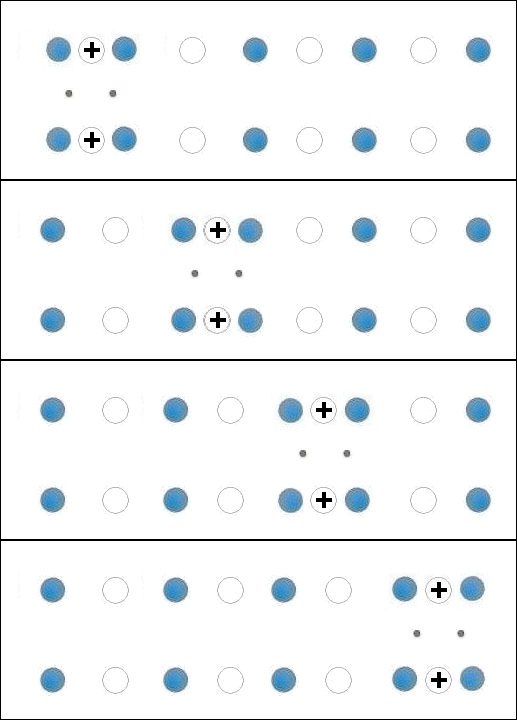 However, in some lattice structures different unit cells have different resonant frequencies — as in the 109 Kelvin superconductor. The 3212 sub-structure (at left) shows 8 tin atoms and an extra copper atom (labeled Heavy because it's more massive), while the 1212 sub-structure shows 4 tin atoms (labeled Light). The net result is the wave fronts generated by the respective sub-structures (page top in green) bounce off their out-of-sync neighbors, creating a reflected wave (in blue). The two waves then combine (in red) to produce a standing wave. It is called this because it is fixed in place topographically based on frequency, lattice dimensions, and the velocity of phonons in the material. This is illustrated below. 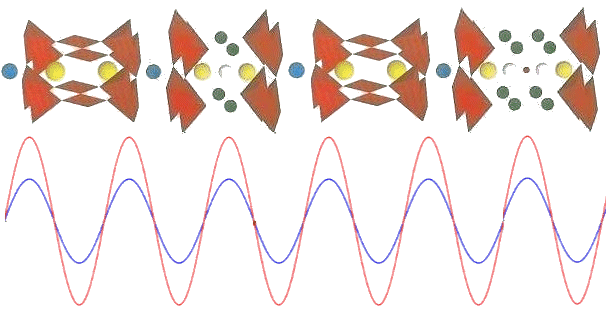 |
Synthesis of this material was by the solid state reaction method. Stoichiometric amounts of the below precursors were mixed, pelletized and sintered for 11 hours at 875C. The pellet was then annealed for 10 hours at 500C in flowing O2.
SnO 99.9% (Alfa Aesar) BACK to "News" page at Superconductors.ORG