|
From maglev trains to particle accelerators to MRI machines, YBCO has filled numerous superconductor niches since its discovery nearly 40 years ago. But it's not perfect. As the first "high temperature" superconductor, it has a critical transition temperature well above the boiling point of liquid nitrogen (92K-vs-77K) — but has resisted almost all attempts aimed at improving its performance. Superconductors.ORG herein reports the discovery of a new rare-earth superconductor (ReBCO) that should outperform YBCO in every critical category: transition temperature (Tc), current density (Jc) and magnetic field (Hc).
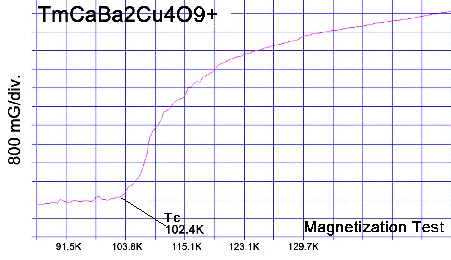
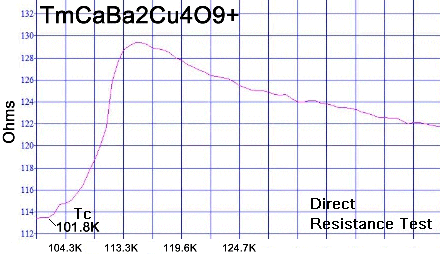
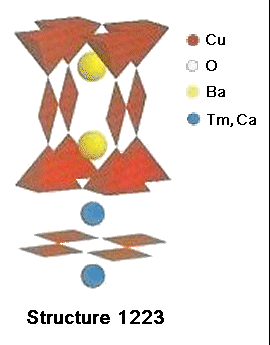
This new superconductor, TmCaBa2Cu4O9+, takes the YBCO structure and substitutes Thulium into the Yttrium atomic site. In 1987 Neumeier, et al, proved a Thulium-123 analog of YBCO could withstand an upper critical field (Hc2) of 1 Mega-Gauss.[1] This extrapolates to a magnetic field of roughly 36 Tesla at 77 K. Since then TmBCO has been used for high-field applications (Hirr), due to its strong pinning centers, with enhanced vortex pinning properties, particularly under high magnetic fields. However, the Neumeier analog also showed a Tc drop to 90 Kelvin — 2 degrees lower than YBCO. So the next order of business was to increase Tc. This has now been achieved by applying planar weight disparity across the apical oxygen ions. Looking at the 1223 structure at left, Calcium has been placed collinearly in the C2 axis so that there are now 3 heavy atoms (2 Barium and 1 Thulium) in line with a light Calcium atom. This gives a planar weight ratio of over 11-to-1. With this arrangement Tc is increased from 90K to around 102K (see plots at page top). Use of Calcium also has the added benefit of increasing the critical current density (Jc) up to 35% across grain boundaries, as was confirmed in bulk Y-123 by Brookhaven National Laboratory researchers in 2005.[2] The TmCaBa2Cu4O9+ result, including an extra copper-oxide plane, has a unit cell that is just slightly larger, but should perform significantly better than legacy YBCO. Further, tests suggest its volume fraction is comparable to the VF of YBCO. The only minority phases observed were near 147K and 167K — well above the majority phase Tc of 102K. 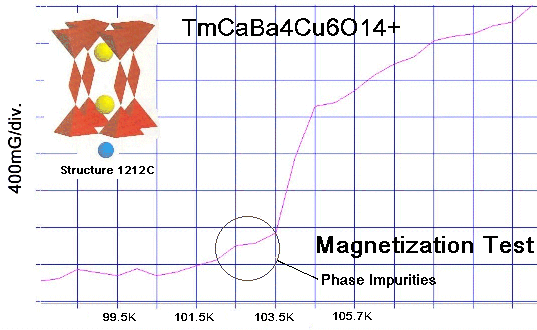
|
The chemical precursors were mixed thoroughly in acetone, dried and pelletized. Then the pellet was calcined at 770C for 1 hour and sintered for 9 hours at 875C. Lastly, it was annealed for 10+ hours at 500C in flowing O2. Testing temperatures were determined using an Omega type "T" thermocouple. The magnetometer employed a single Honeywell SS94A1F Hall-effect sensor with a sensitivity of 25 mv/Gauss operating within an ambient magnetic field of 550-600 milliGauss
RESEARCH NOTE: The copper-oxides are strongly hygroscopic. All tests should be performed immediately after annealing.
E. Joe Eck
© 2026 Superconductors.ORG
All rights reserved.
 BACK to "News" page at Superconductors.ORG